
IAN STEPHENSON
PLANES OF HEAVEN
Open from Saturday 20 June 2026
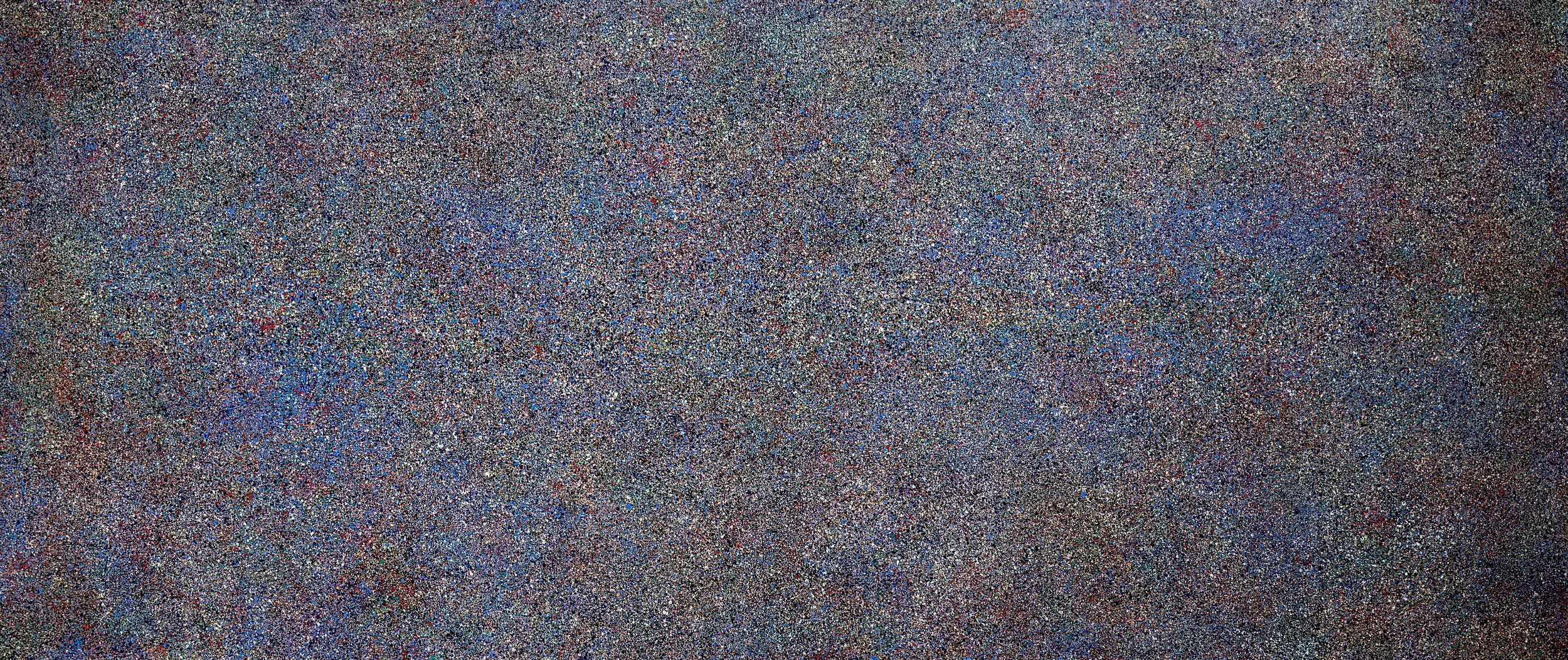
A ground breaking exhibition concentrating on Ian Stephenson’s large works from the late 1960s and early 70s. When viewed from a distance these grand paintings made from tiny drops of paint appear vast and diffuse; there is a sense of endlessness on the largest scale, although experienced intimately, as in a lyric mode. They also draw one towards them; the closer one looks at them, the more dots one sees, uncountable thousands of them. The outlines of the dots become sharper, and the paintings more precise. There is a surprising and considerable range in scale between the largest dots and the smallest pinpricks of colour, dots within dots, an experience of endlessness on the smallest scale, although experienced impersonally, as in an epic mode. The suggestion of an ever-opening multicoloured plane may have one of its distant origins in John Martin’s vast “Plains Of Heaven”, a print of which hung on his aunt’s wall and the only painting Ian remembered from his childhood. These great paintings of flux still the mind in contemplation of their wholeness, harmony, and radiance.
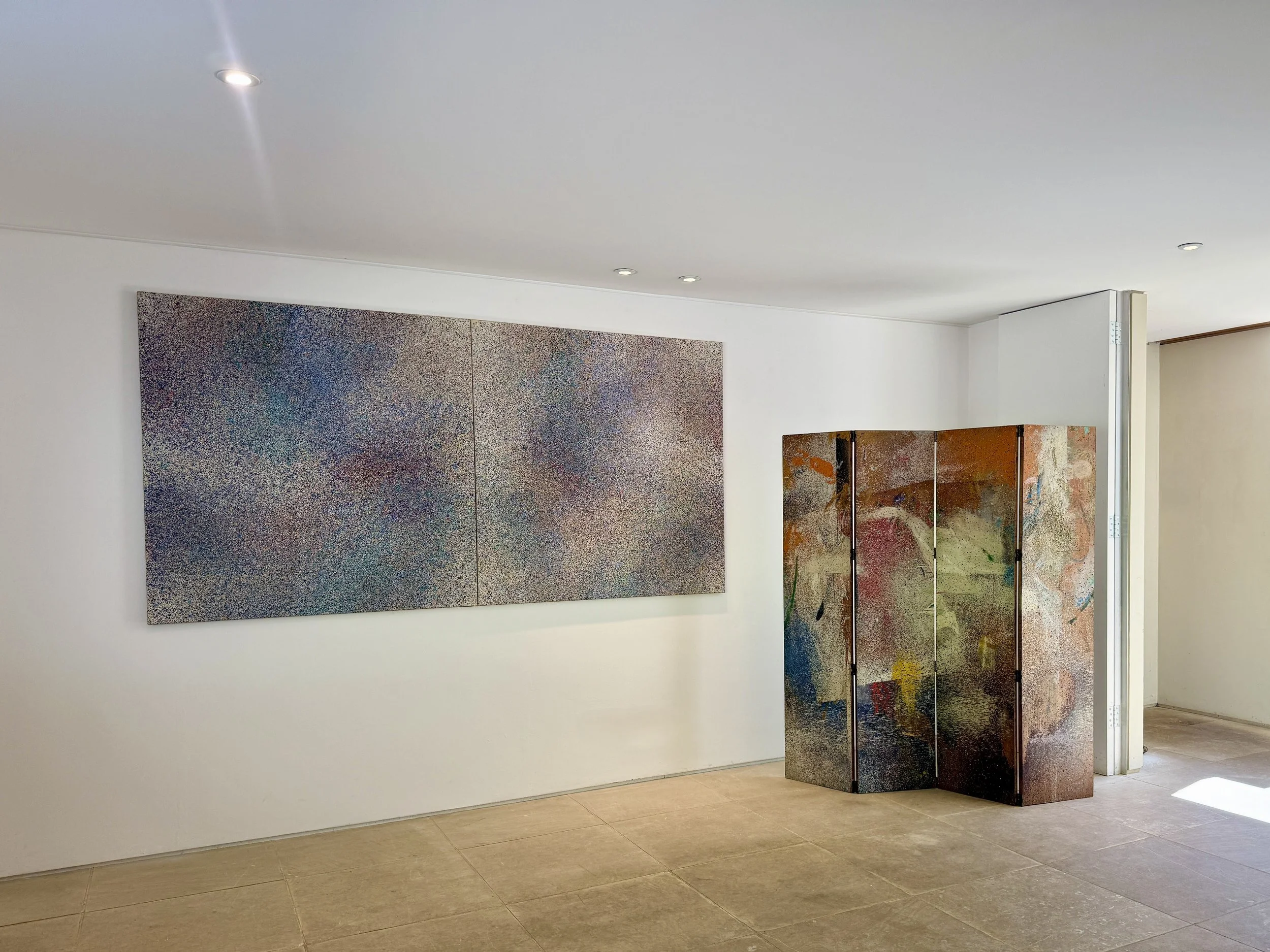
Left: Ian Stephenson, Diorama, 1967, Oil on canvas, 122 x 244 cm
Right: Ian Stephenson, Screen (featured in Antonioni's film 'Blowup' in 1966), 1960, Oil on board, 165.1 x 152.4 cm
A selection of his earlier small paintings and sketches, to show the development of his ideas, will be seen in the Artist’s House. The exhibition is accompanied by an essay by the art historian and guest curator Chris Yetton, tracing how the development of Stephenson’s painting ideas and technique from post-impressionism, divisionism, cubo-futurism to a form of abstraction, made from drops of paint falling vertically like rain onto horizontal canvases, came together with his love of images from astronomy and atomic physics. The essay draws upon new discoveries made in the very extensive Stephenson archive including his work towards a post-graduate thesis on the eighteenth century astronomer Thomas Wright and his ideas leading to the development in painting of what he termed an ‘atomic surface’. These ideas were integrated with his love of English Romantic painting and poetry. Stephenson used images coming from fundamental physics, on both the atomic and astronomic scales, as metaphors for the operation of the mind when faced with an ultimate physical reality so immensely distant from our human scale, leading to paintings with clear ethical import.

Ian Stephenson Planes of Heaven on display in the Main Gallery
