
Victor Pasmore
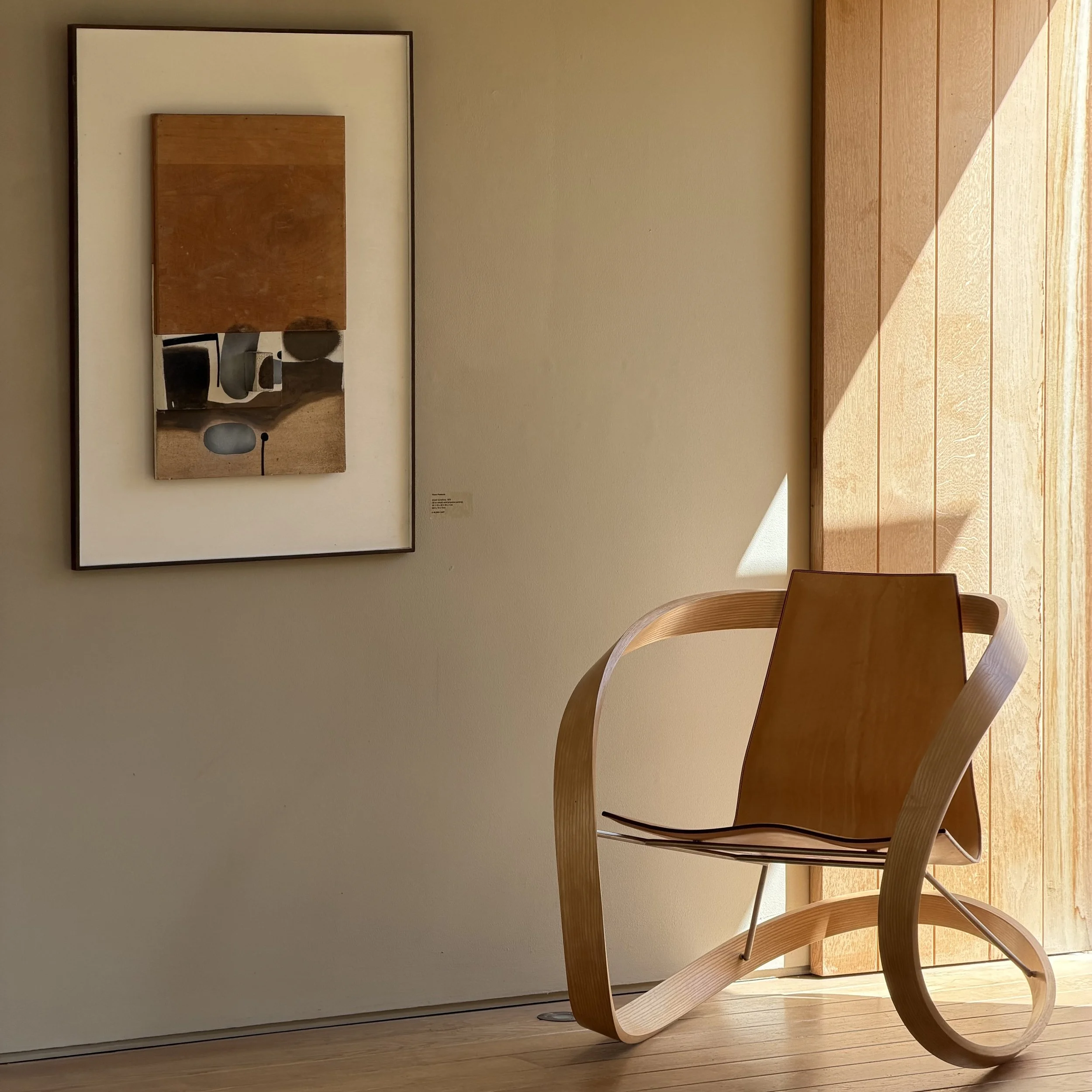
Victor Pasmore
Brown Symphony
1975
Oil on natural wood projective painting
99.5 x 72 x 10cm
3ft 3 1/8 x 2ft 4 3/8 x 4 in.
Katie Walker
Ribbon rocking chair
Designed 2006, Made 2018
Ash, brushed stainless steel and natural vegetable tanned saddle leather
86 x 79 x 113 cm
2ft 9 ⅞ x 2ft 7 ⅛ x 3ft 8 ½ in.
Victor Pasmore (1908-98) was a major figure in the revival of Constructivism in Britain following World War II. He believed that all art was derived from nature, but specifically from its underlying structure rather than its surface appearance. His abstract work, often in collage and construction reliefs, pioneered the use of new materials and was sometimes on a large architectural scale. Herbert Read described the development of Pasmore's style as 'the most revolutionary event in post-war British art'.
Pasmore was born in Chelsham, Surrey. Whilst working for the London County Council he studied painting part-time at the Central School and developed a lyrical figurative style; early support from Sir Kenneth Clark allowed Pasmore to concentrate on his artistic career. By 1948, Pasmore had developed a purely abstract style having been influenced initially by British artists such as Nicholson and others associated with Circle, but also international exhibitions he saw in London of works by Picasso and Klee.
Pasmore became a leading figure in the reform of the fine art education system. The course he founded called ‘The Developing Process’ was inspired by the Bauhaus movement and became a model adopted for higher arts education across the UK. Pasmore designed a mural for the Festival of Britian and was involved in This is Tomorrow, the seminal exhibition at the Whitechapel Art Gallery in 1957. He participated in documenta II in 1959 and represented Britain in the Venice Biennale in 1960 and again at the São Paulo Bienal in 1965, the same year as his retrospective at Tate. Pasmore was appointed Consulting Director of Urban Design for Peterlee, County Durham in 1954; the ‘Pavilion’ he designed there in 1970 is regarded as a synthesis of Pasmore’s interest in architecture, sculpture and painting. Pasmore was a Royal Academician, a C.B.E. and a Companion of Honour.
Today, Victor Pasmore’s work can be found in numerous public collections, including at the Museum of Modern Art, New York, USA; the Yale Center for British Art, Connecticut, USA; the Deutsche Bank Collection, Germany; and the Tate Gallery, London, UK. The New Art Centre has shown a range of his works; most notably in the exhibition Victor Pasmore: From Constructions to Spray Paint in 2011 and 2012. The exhibition paired Pasmore’s constructed reliefs from the 1960s with his dynamic paintings from the 1990s, two of the most important decades of the artist’s career.
Please contact us for more information on work by Victor Pasmore.