
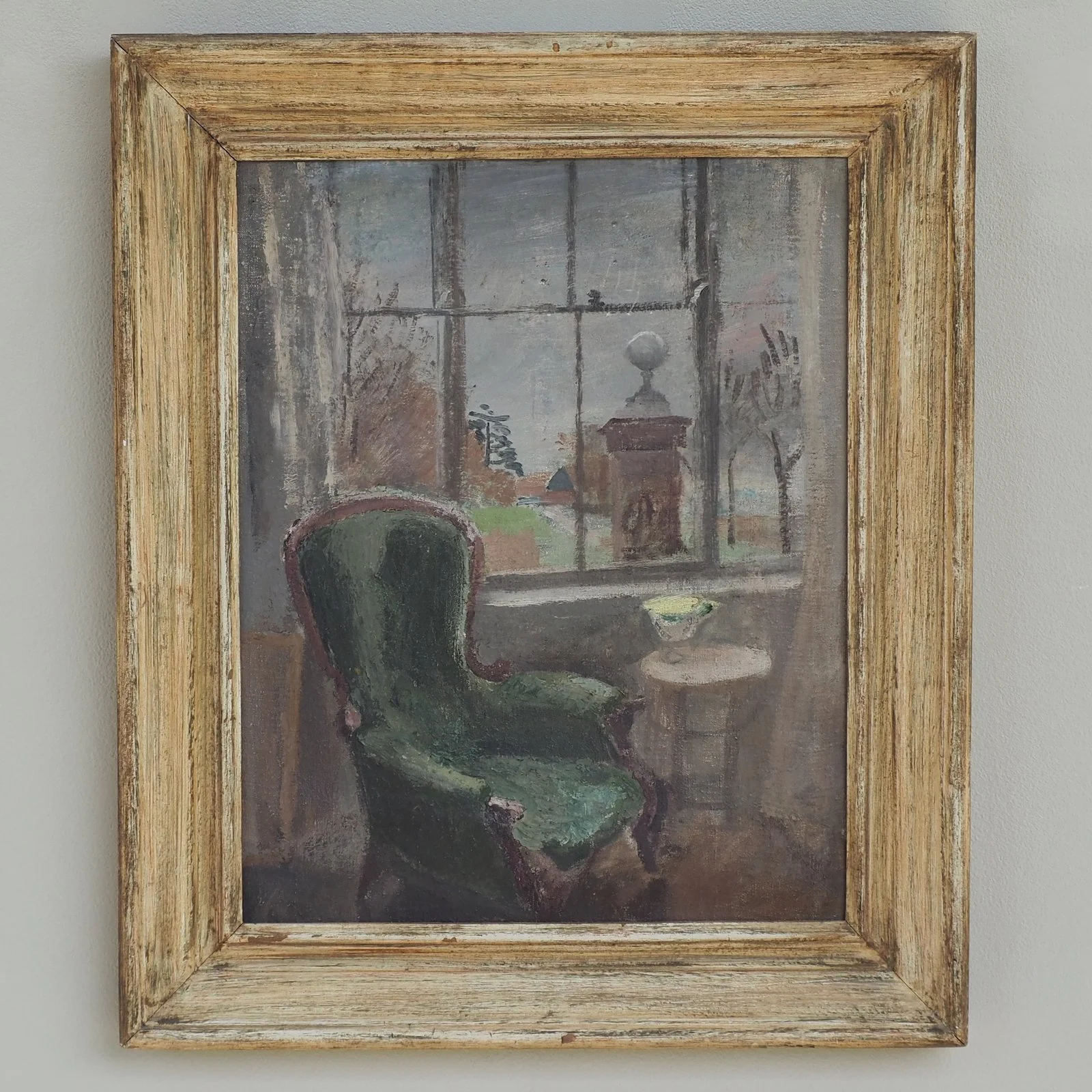
WORK OF THE WEEK: Mary Potter, Winter Afternoon, 1944
Mary Potter
Winter Afternoon
c.1944
Oil on Canvas - Signed and inscribed on the stretcher 'Winter Afternoon, Mary Potter'
image: 49 x 39 cm / 19 ¼ x 15 ⅜ in.
frame: 65.5 x 55.5 cm / 25 ¾ x 21 ⅞ in.
Last Saturday, the New Art Centre welcomed guests to the opening of our new exhibition in the Main Gallery: a collection of Mary Potter paintings spanning three decades of work. The exhibition was introduced by Doctor Timothy Revell of the National Gallery, who read Lord Clark's introduction to Potter's Whitechapel Art Gallery exhibition in 1964. Alongside him was Madeleine Bessborough, the founder of the New Art Centre who represented Mary Potter during the pivotal period of her career when her work began to move into abstraction. Over the coming months, we would like to observe this shift, beginning with the earliest painting on display, Winter Afternoon (1944).
Winter Afternoon was painted during Potter's time at Berwick Hall, Essex, where she lived with her husband and children during the final three years of the war. Having spent the previous years in Manchester, working for the BBC and mainly painting portraits, Berwick Hall provided something of a respite, '(Potter's) career was well served by the Berwick Hall period, since there she had plenty of opportunity to work and she stored up many paintings for exhibition later. As ever, she painted the view from her studio window.' (Mary Potter, A Life of Painting). One such painting, Winter Afternoon was painted in 1944.
We see the lingering influence from her time at The Slade, where under the teaching of Henry Tonks, who favoured realism, she learnt 'that students should look hard at the object before them and depict exactly what they saw.' (Julian Potter, 1998) The room, a sitting room made studio, is portrayed at a more distanced perspective in Country Studio (1944), yet we recognise one of the pillars at the gate of Berwick Hall, and the dark green armchair. An empty frame leaning against the wall in the bottom left corner is indicative of the room's haphazard multi-purposing of a temporary stay. Whilst the painting is certainly rooted in realism, the familiar view is manifested into a dreamscape. The objects closest to the viewer are made real through meticulous shadowing and mark-making, yet the distant trees and drive dwindle into abstraction. The immediate epicentre is tactile and visceral, but ripples out to an encroaching winter haze cloaked by a grey sky, giving the room a sense of safety and vitality in surrounding scenes of uncertainty.
To find out more about the exhibition, or to book a visit, please enquire below: