
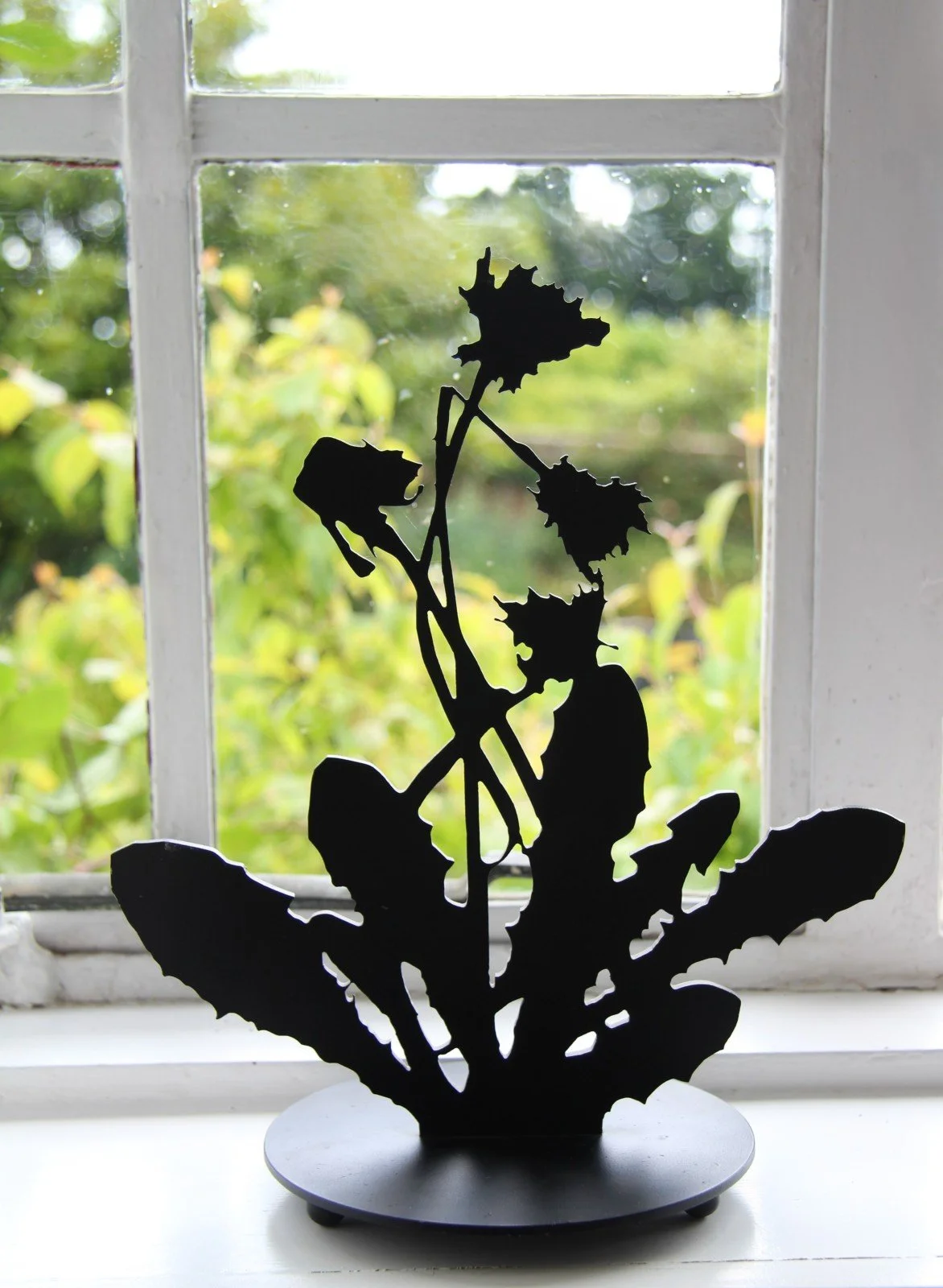
WORK OF THE WEEK: Paul Morrison, Topocline, 2005
Paul Morrison
Topocline
2005
Painted aluminium
27.5 x 14 x 14 cm
10 ¾ x 5 ½ x 5 ½ in.
'Not unlike Alice's psychedelic-tinged Wonderland, many of Morrison's hypnotic fantasy environments seem to pivot between innocence and malevolence in the blink of an eye. Morrison alters our sense of scale, perspective, and positive-negative space to create visually striking compositions.'
Hammer Museum, Los Angeles
Like thin silhouettes of fauna haloed by the setting sun, the monochrome works of Paul Morrison seem to occupy a liminal space of twilight. In both form and feeling, his sculptures walk a fine line between reality and fantasy, their inspiration drawn from botanical guides and children's storybooks. Known for his landscape paintings and large-scale sculptures, such as Hyazinthe, which recently left Roche Court, Morrison is celebrated as an artist who explores the language of the Op Art Movement in the natural world. As such, the New Art Centre would like to highlight his smaller works, such as Topocline.
A topocline refers to a linear gradient in the landscape that appears to have no ecological explanation. A fitting title for this piece; the flower has a depth of half a centimetre, appearing as straight line when observed from its side. Its titling lends itself to the sense of the uncanny and inexplicable that Morrison imbues in his sculptures. Made from aluminium and painted black, distractions are muted, encouraging the viewer to notice and relish in its form.
Morrison studied at Goldsmiths' College from 1995-98. He has shown widely across the UK, Europe and the USA. Solo shows of his work have been hosted at the Millennium Gallery, Sheffield, Rhode Island School of Design, the Las Vegas Art Museum, Bloomberg Space in London, Fondazione Volume, Rome, Galleria d'Arte Moderna e Contemporanea, Bergamo, Kunstverein Ulm, Art & Public, Geneva, Tomio Koyama Gallery and Taro Nasu, Tokyo, Le Magasin, Grenoble, Kunsthalle Nürnberg, PS in Amsterdam, The Contemporary Museum of Honolulu, the Irish Museum of Modern Art in Dublin, the Aspen Art Museum, and The Hammer Museum, Los Angeles, amongst other locations. In 2024, Sea Oak, a large, reflective sculpture, was installed at Scarborough Harbour, depicting the image of Fucus vesiculosus (commonly known as Bladderwrack), an ecologically vital seaweed species native to the UK. The reflection offered by the polished, stainless steel reflects the changing conditions of sea and sky, as well as the viewer, prompting us to reflect on our interdependent relationship with the natural world.