
WORK OF THE WEEK: Paul Mount, The Erl King, 2008
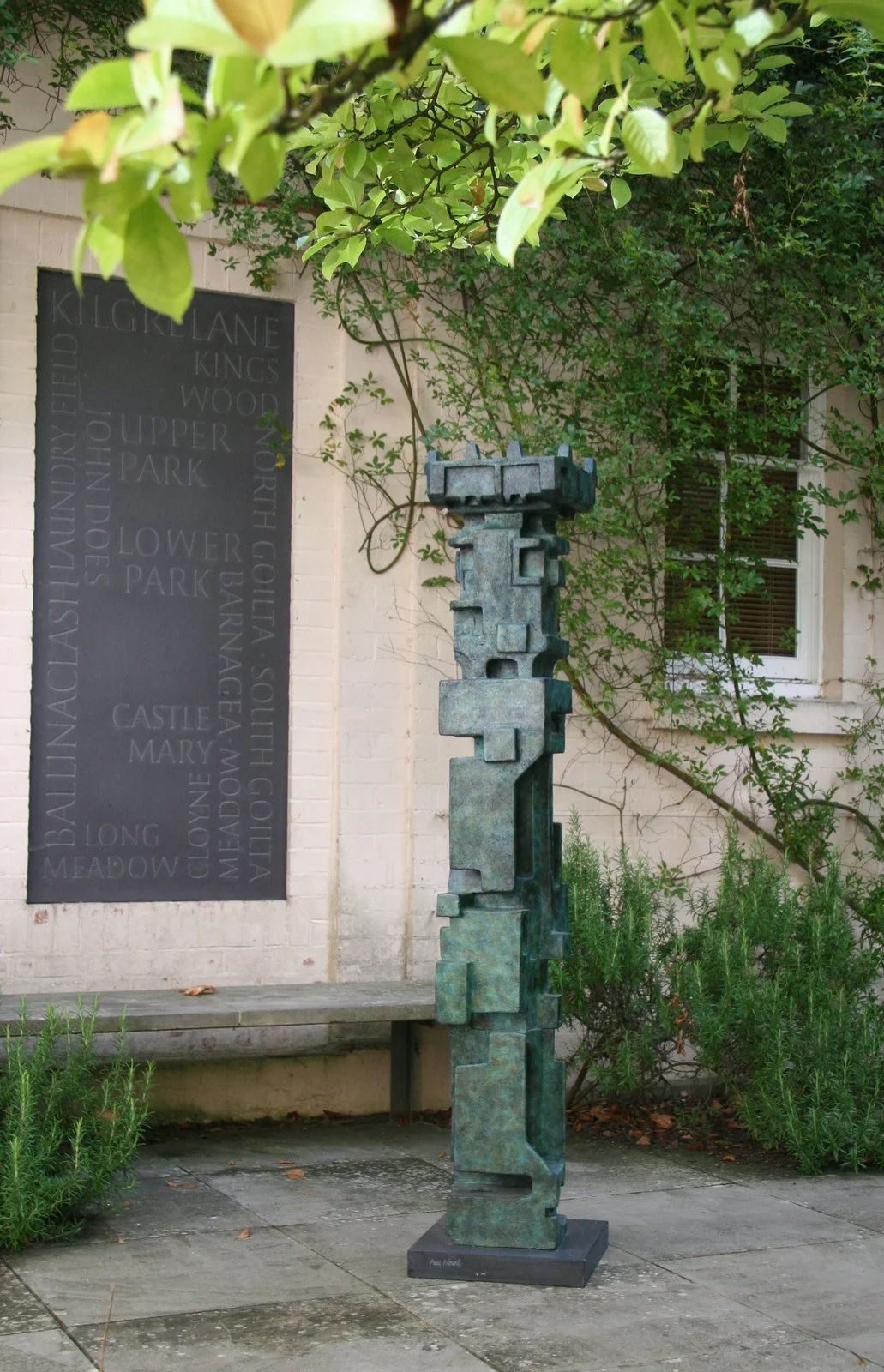
Paul Mount
The Erl King
2008
Bronze
169 x 35.5 x 35.5 cm
66 ½ x 14 x 14 in.
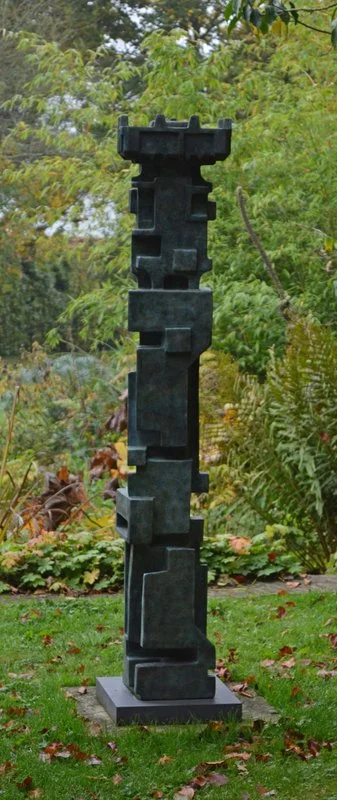
Paul Mount's The Erl King, a totemic sculpture cast in bronze, alludes to the mystical 'Erlking' of European folklore, a sinister elf, or the King of the Fairies. 'Der Erlkönig' (The Erl King) is a famous poem written by Johann Wolfgang von Goethe in 1782, in which a father and son travel through the night. The boy, tormented by the Erlking, dies before they can reach their destination. In the poem, the father dismisses the boy's sightings for natural phenomena: 'the mist', 'the wind', 'the aged grey willows.' In much the same way, Paul Mount's sculpture, although abstract, hovers on the peripheral; at a glance, one may imagine the sinister figure. We see the crown, the inward curve where a neck would be, and the layered shapes and oxidised bronze give it an uncanny, otherworldly sense.
Paul Mount (1922 - 2009) always had great interest in totemic forms. A pioneer of sculptural abstraction in the 20th Century, he was known for his ability to integrate futurist, geometrical forms with the material sensitivity of African sculpture.

Paul Mount
Rhomba
1982
Stainless steel
51 x 54 x 49 cm
1ft 8 x 1ft 9 ¼ x 1ft 7 ¼ in.
Unique
After leaving the Royal College of Art, Mount was heavily influenced by his move to Nigeria in 1955. Experimenting with traditional Nigerian materials, including iroko and ebony, enhanced his understanding of direct carving and casting. Mount conceived his sculptures in relation to their surroundings, believing the way two shapes relate is as important as the way two people relate, creating evocative and lively works that beautifully shift their constituent forms. Mount returned to England where he settled near St Just, Cornwall.
The New Art Centre has shown Paul Mount’s work for many years, with his first solo exhibition at the gallery on Sloane Street in 1978. From this point, Mount had four further solo shows with the New Art Centre, his work also being consistently shown at Roche Court Sculpture Park.
'Who rides there so late through the night dark and drear?
The father it is, with his infant so dear;
He holdeth the boy tightly clasp'd in his arm,
He holdeth him safely, he keepeth him warm.
“My son, wherefore seek'st thou thy face thus to hide?”
“Look, father, the Erl-King is close by our side!
Dost see not the Erl-King, with crown and with train?”
“My son, 'tis the mist rising over the plain.”
“Oh, come, thou dear infant! oh come thou with me!
Full many a game I will play there with thee;
On my strand, lovely flowers their blossoms unfold,
My mother shall grace thee with garments of gold.”
“My father, my father, and dost thou not hear
The words that the Erl-King now breathes in mine ear?”
“Be calm, dearest child, 'tis thy fancy deceives;
'Tis the sad wind that sighs through the withering leaves.”
“Wilt go, then, dear infant, wilt go with me there?
My daughters shall tend thee with sisterly care
My daughters by night their glad festival keep,
They'll dance thee, and rock thee, and sing thee to sleep.”
“My father, my father, and dost thou not see,
How the Erl-King his daughters has brought here for me?”
“My darling, my darling, I see it aright,
'Tis the aged grey willows deceiving thy sight.”
“I love thee, I'm charm'd by thy beauty, dear boy!
And if thou'rt unwilling, then force I'll employ.”
“My father, my father, he seizes me fast,
Full sorely the Erl-King has hurt me at last.”
The father now gallops, with terror half wild,
He grasps in his arms the poor shuddering child;
He reaches his courtyard with toil and with dread,—
The child in his arms finds he motionless, dead.'
- The Erl King, 1782, by Johann Wolfgang von Goethe. Translated by Sir Walter Scott.