
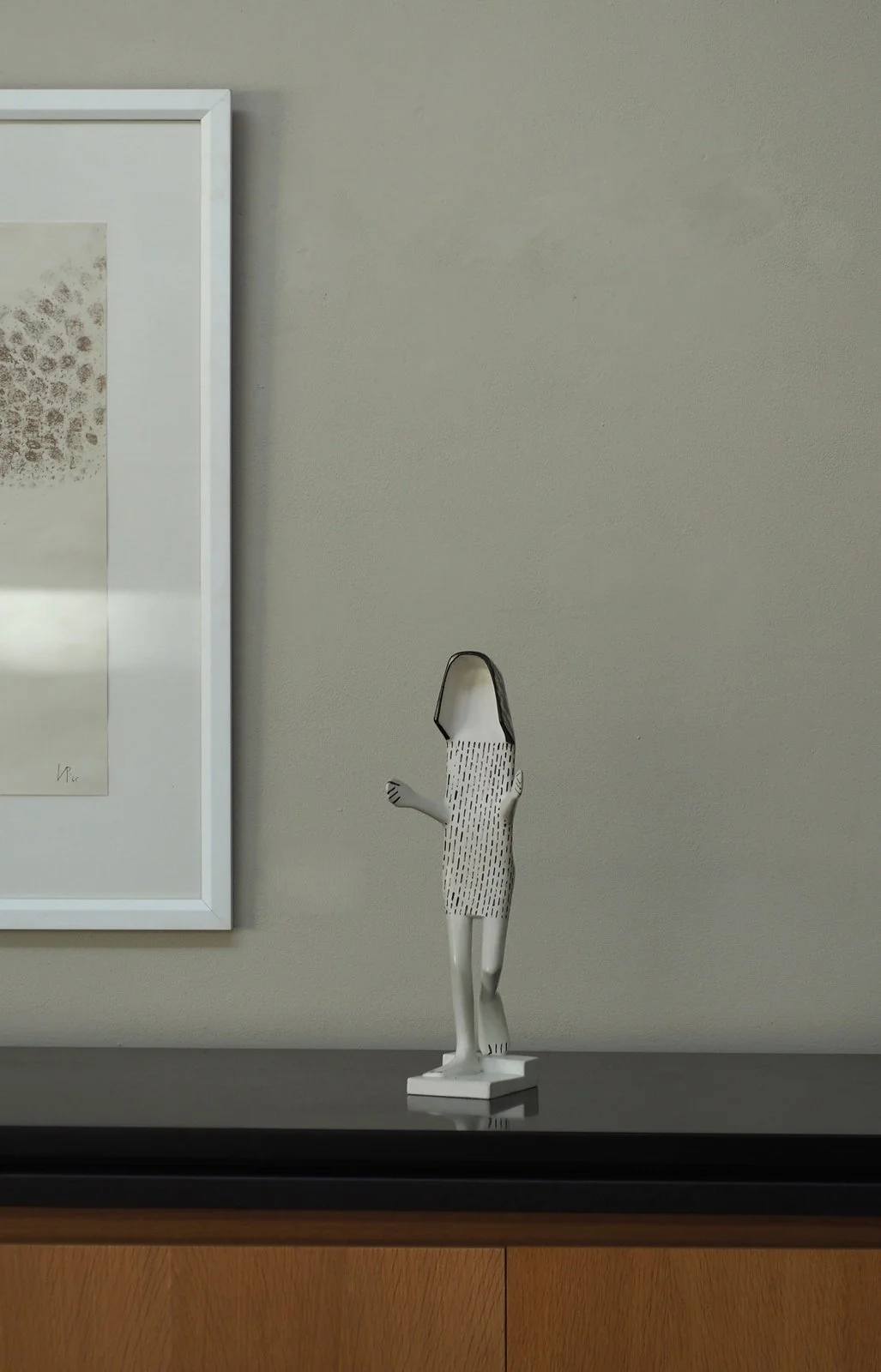
Kenneth Armitage
Girl in a striped skirt
1974-75
Signed and dated 'KA 1974' (on base) also signed, dated and editioned 'KA CAST 1975 2/6' (on underside of base)
Aluminium with sprayed white paint and drawing
42 x 13.5 x 11.5 cm
16 1/2 x 5 1/4 x 4 1/2 in.
Ed. 2 of 6
Kenneth Armitage (1916-2002) was part of the great renaissance of British sculpture in the early post-war years. The art of bronze casting had been in severe decline because of the austerity of the post-war years; his very early works were carved in stone, but in later years he began casting in bronze, initially using plaster modelled on metal armatures, later using clay. By the 1960s, Armitage had begun working with wax, resin, and aluminium.
Armitage was made an Honorary Fellow of the Royal College of Art in 1965, and became an Honorary Doctor in 1969. In 1974, he began to teach there one day a week. It was during this time that he completed Girl in a striped skirt, one of the final figurative pieces he made before he took to drawing and sculpting oak trees, an infatuation that lasted a decade. Girl in a striped skirt was shown in Kenneth Armitage's solo exhibition at Gallery Kasahara, Osaka, in 1974.
The early 70s saw an interest in the combination of drawing and sculpture, experimenting with photographic, drawn and printed images of figures on three-dimensional surfaces. The delicacy of Girl in a striped skirt, its brightness and lightness, give the impression of a porcelain composition. Armitage had a wonderful ability of manipulating metals into abstract figures that embody an otherworldly lightness and ease, nevertheless they possess a quintessential humanity. The raised foot and forward tilt lend themselves to this impression, imbuing the sculpture with movement and purpose. Faceless though not eerie, Girl in a striped skirt is a beautiful example of Kenneth Armitage's sensitive and joyful sculpture.
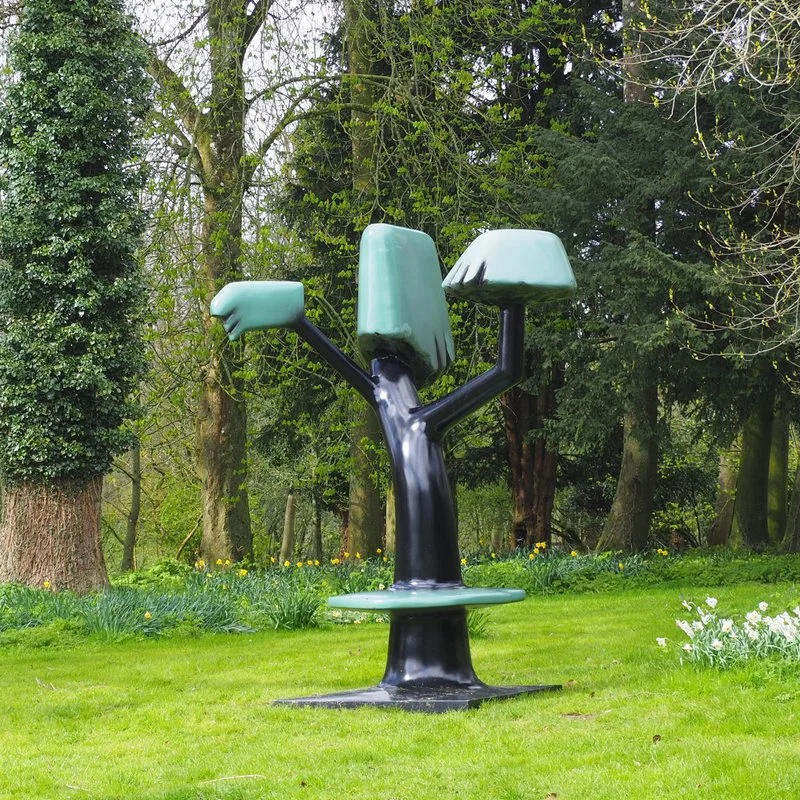
Kenneth Armitage
Richmond Oak
1985 (cast 1990)
Bronze
305 x 190.5 x 240 cm
10ft x 6ft 3 x 7ft 6 ½ in.
Edition of 3 (#2/3)
In 1985, Armitage was commissioned to place a sculpture in the city of Brasilia, Brazil, to be situated at the British Embassy there. Renowned and admired for his figurative works, they were hoping for such a sculpture. However, on visiting Brasilia, Armitage was saddened by its lack of greenery, and sculpted instead a tree. Richmond Oak, with its bright colour and stylised form, reflects the newness and industrialisation of culture in the 1980s, fitting for its site in the relatively young city of Brasilia. Simultaneously, it regards the oak tree as a representation of English tradition and history – a symbol of home in faraway lands.
The first edition of Richmond Oak remains at the British Embassy in Brasilia, a Capital designed by the architect Oscar Niemeyer. The second edition is situated at Roche Court Sculpture Park and the third was displayed at Yokohama Park, in Japan.
The New Art Centre represents the Estate of Kenneth Armitage. To find out more, please enquire below: