
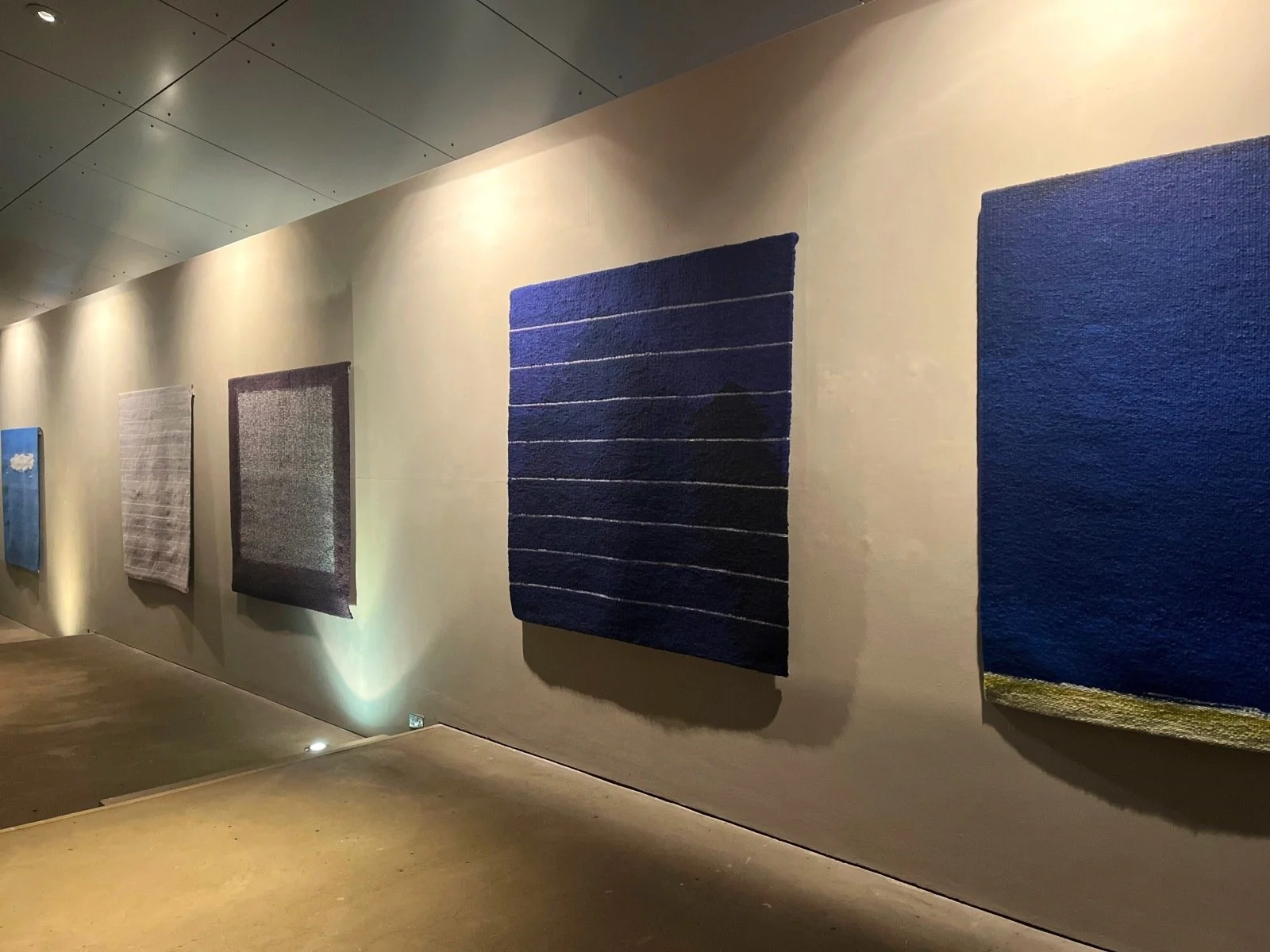
Justine Randall
The Night Sky Tapestries Exhibition
The New Art Centre's current exhibition, Justine Randall: The Night Sky Tapestries, is invaluable to architects and designers. It highlights how tapestry may transform a space, absorbing sound and bringing warmth and colour to even the most utilitarian architectural spaces. The Night Sky tapestries continue a long conversation in British Art, which includes the tapestries produced by Henry Moore for The Aisled Barn. The Aisled Barn is a beautiful, open building, with high ceilings and exposed beams, which was purchased by Moore in 1980, and carefully reconstructed near his studios. It was in the same year that Moore initiated a decade long project; working with a team of weavers from the Edward James Foundation at West Dean, twenty-three tapestries were produced, with the intention of being hung from the wooden beams in the Aisled Barn.
These tapestries were based off of drawings carefully selected by Moore to be transformed into a different medium. Most of these possessed Moore's quintessential theme of mother-and-child, at the time being at the fore-front of his mind following the birth of his first grandchild. The team of weavers, comprising artists such as Eva-Louise Svensson, Dilys Stinson, Joan Baxter, Valerie Power and Alison Innes, would spend several months on each tapestry, before rolling them up, transporting them to and hanging them in the Aisled Barn to be presented to Moore. It was vital to him not that the tapestries should be blow-ups of his drawings, as he explained
'If it were just going to be a colour reproduction I wouldn't be interested. It is because it is a translation from one medium into another and has to be different that you get a surprise. It is not like a bronze caster who has to produce an absolutely exact copy or it is thrown away; the beauty of tapestry is that it is different, an interpretation, and that is to me the excitement and the pleasure.' (Henry Moore)
Rather, it was essential that these tapestries should work in the architectural space in which he envisioned them. In 2005, several of these tapestries came to The New Art Centre, where they were displayed in The Gallery for the exhibition Henry Moore: Tapestries. The Orangery, pictured below, is a listed building incorporated into The Gallery by the architect Stephen Marshall in 1998. Like the Aisled Barn, The Orangery also possesses high ceilings, with white wooden beams and glass that bathe the space in natural light. Moore's tapestries lined the walls of the Gallery, yet commanded the attention of the viewer as the focal point of this space.
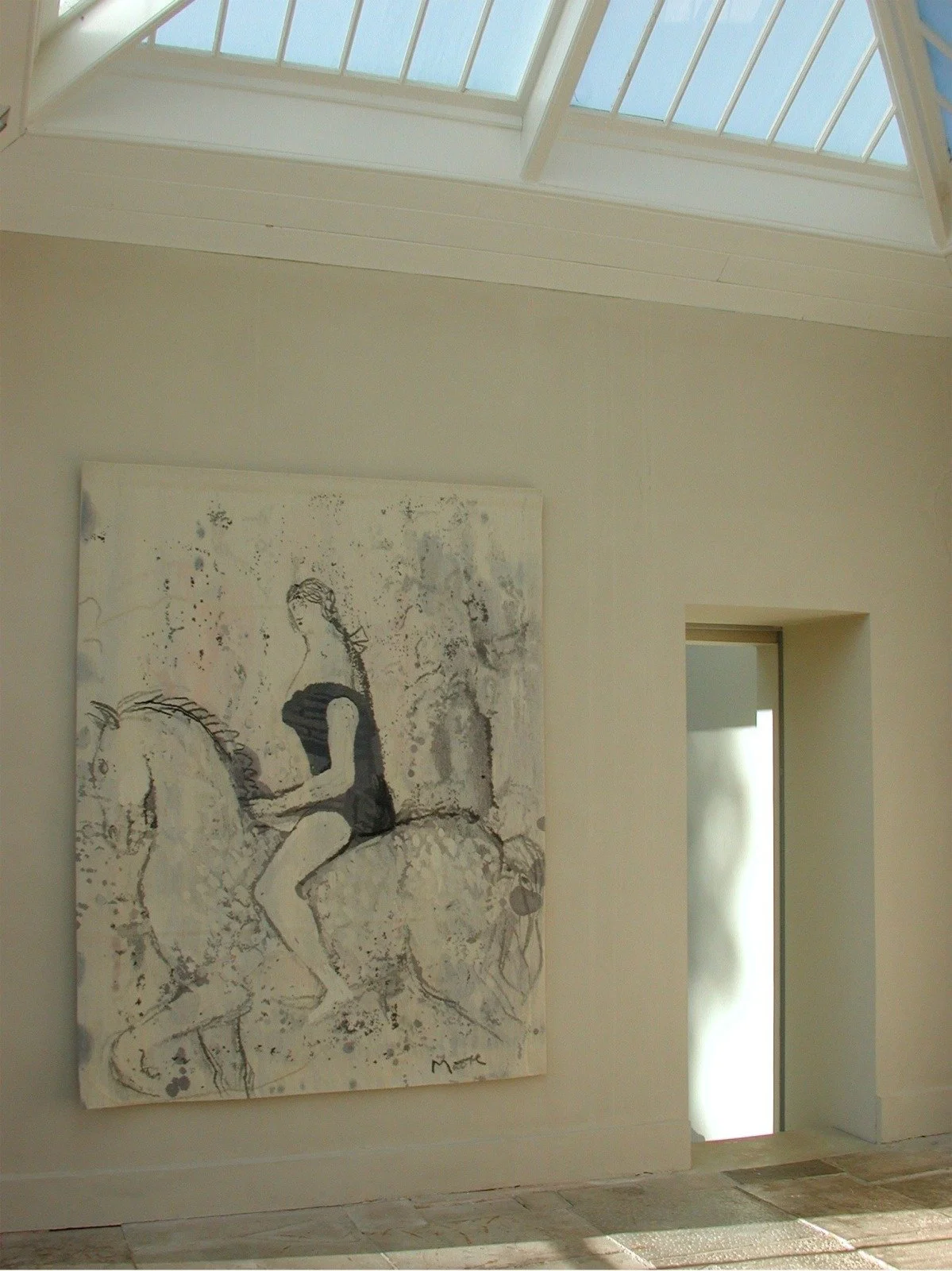
Henry Moore
Circus Rider, 1979 after a drawing of 1975,
Tapestry by West Dean Tapestry Studio
6ft 9 1/2 x 5ft 3 in.
207 x 160cm
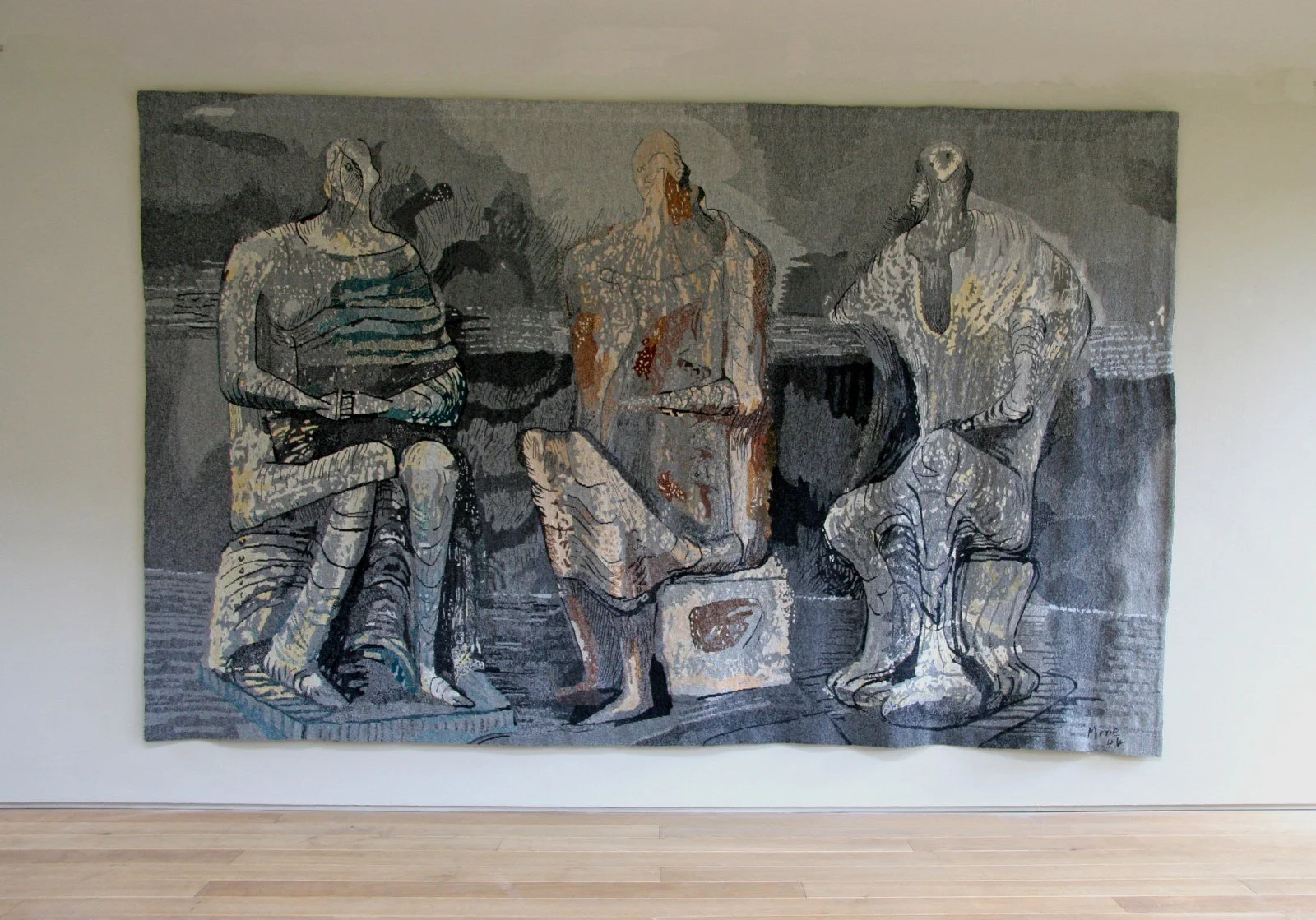
Henry Moore
Three Seated Figures, 1974
Twenty years on, Justine Randall continues this legacy of stressing the importance of tapestry in architectural spaces. Tapestry serves not only an aesthetic function, but furthermore offers a solution to architectural problems. In curating these exhibitions, the New Art Centre has witnessed how tapestries can transform a space; cancelling out echoes, bringing warmth and character, all the while accentuating the details of this meticulously designed gallery, rather than overshadowing them. We at the New Art Centre extend a warm welcome to architects and designers to visit The Night Sky Tapestries exhibition. To book a visit, or to find out more about Justine Randall: The Night Sky Tapestries, please enquire below.