
Prints and Small Sculpture | Catalogue Selections
Bill Woodrow
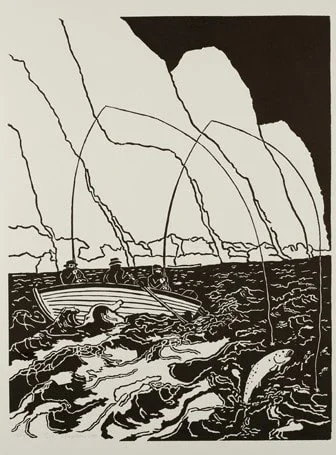
North Shore beat of the Loch Maree Fisheries, 2003
Signed, editioned and dated, 'Bill Woodrow 2003' (lower left)
Linoprint on white Zerkall
270gsm paper
Image: 41 x 31 cm
Bill Woodrow created this striking linoprint in support of the Wester Ross Fisheries Trust, which works to conserve the populations of wild fish in Scotland's lochs through sustainable fishing practices. The smoothness of the white Zerkall paper allows for a rich contrast with the black ink which is so beautifully absorbed, lending itself to the impression of deep, mystical waters.
Barry Flanagan
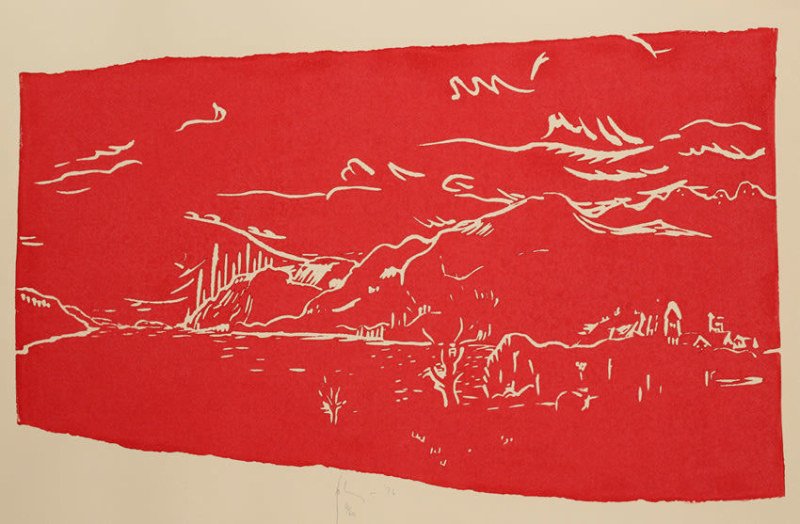
The Abbey, 1976
Linocut
Framed: 51 x 69 cm / 20 x 27 ¼ in.
Unframed: 38 x 56 cm / 15 x 22 in.
Barry Flanagan
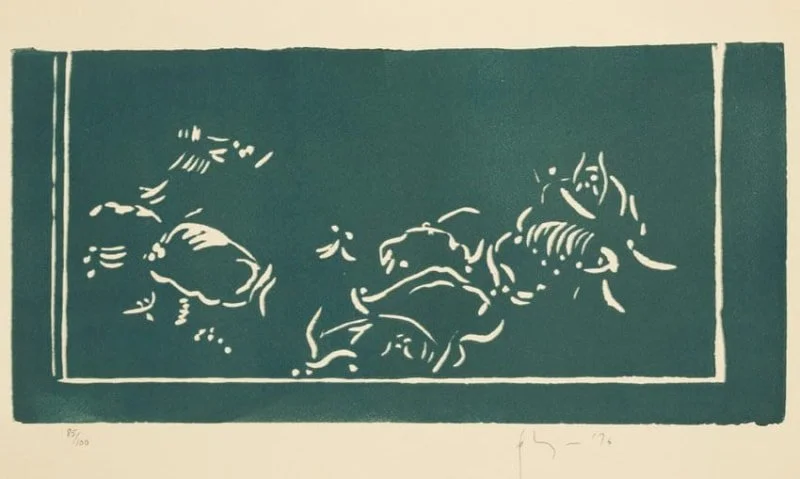
Stones (was titled Dark Blue), 1976
Linocut
Framed: 32 x 45 cm / 12 ½ x 17 ¾ in.
Unframed: 19 x 38 cm / 7 ½ x 15 in.
Barry Flanagan
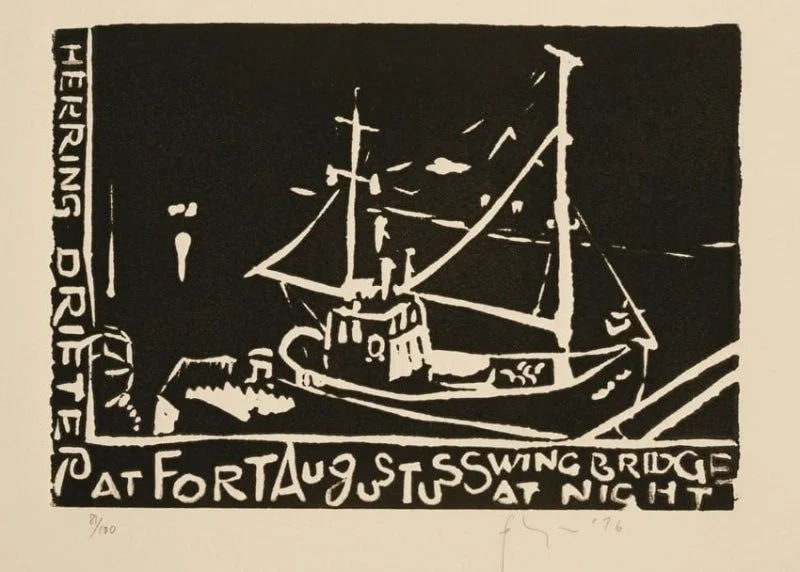
Herring Drifter at Fort Augustus, 1976
Linocut
Unframed: 19 x 29 cm / 7 ½ x 11 ½ in.
Framed: 34 x 38 cm / 13 ⅜ x 15 in.
The New Art Centre is home to a selection of Barry Flanagan Linocuts. From bronze, anthropomorphic figures of hares, to abstract compositions of cloth and rope; Flanagan explored the depths of each medium he encountered with relish. The same can only be said for his Linocuts, of which The Abbey, Stones and Herring Drifter at Fort Augustus, were commissioned by Bernard Jacobson Gallery, and were made during a visit to Loch Ness. Whilst there, Flanagan attended a mass at the Abbey at Fort Augustus. 'He has said that the red colour of this print was inspired by the vestments of priests at the service' (conversation with Jeremy Lewison of the Tate Gallery on 21 August 1985)
Flanagan's use of positive and negative space create unique, playful images. The deep, consuming use of colour render these pieces the focal point of any space. For more information on Barry Flanagan's work, please enquire below:
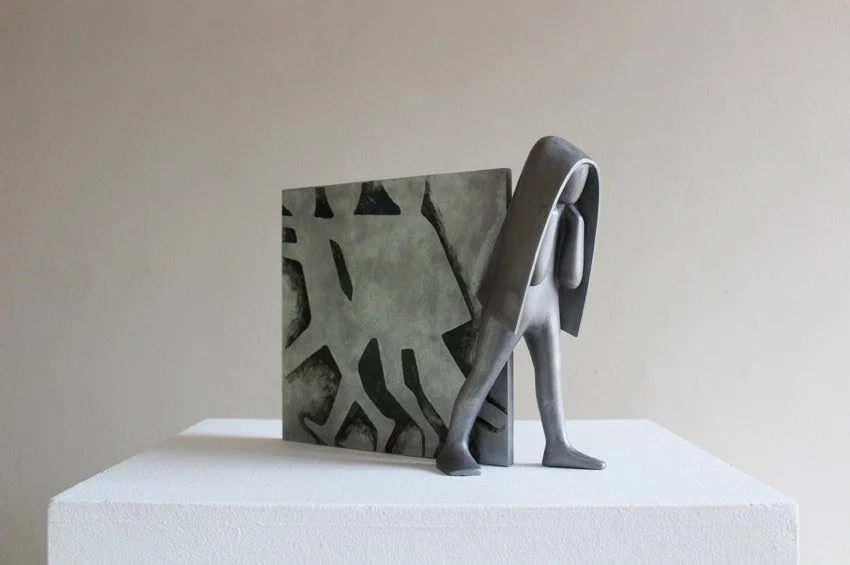
Kenneth Armitage
Bernadette Going to Wales, 1972 (cast 1986)
Aluminium and gloss paint
24.5 x 29 x 9 cm
9 ⅝ x 11 ⅜ x 3 ½ in.
Kenneth Armitage (1916-2002) was part of the great renaissance of British sculpture in the early post-war years; a renaissance which was appreciated by museums and collectors in New York and Europe even more than in Britain. The art of bronze casting had been in severe decline because of the austerity of the post-war years; his very early works were carved in stone, but in the post-war years he began casting in bronze, initially using plaster modelled on metal armatures, later using clay. By the 1960s, Armitage had begun working with wax, resin and aluminium. Bernadette Going to Wales is one such sculpture, cast in aluminium, it speaks to the attentiveness, and humour, of the artist. The forward tilt of the shrouded figure gives the impression of weighted movement: a slow and steady pilgrimage. Despite the depicted fleeing of figures from where Bernadette is headed, she is so determined in her expedition that she is rendered three-dimensional, emerging from the sculpture and carrying the weight of it in her resolve.
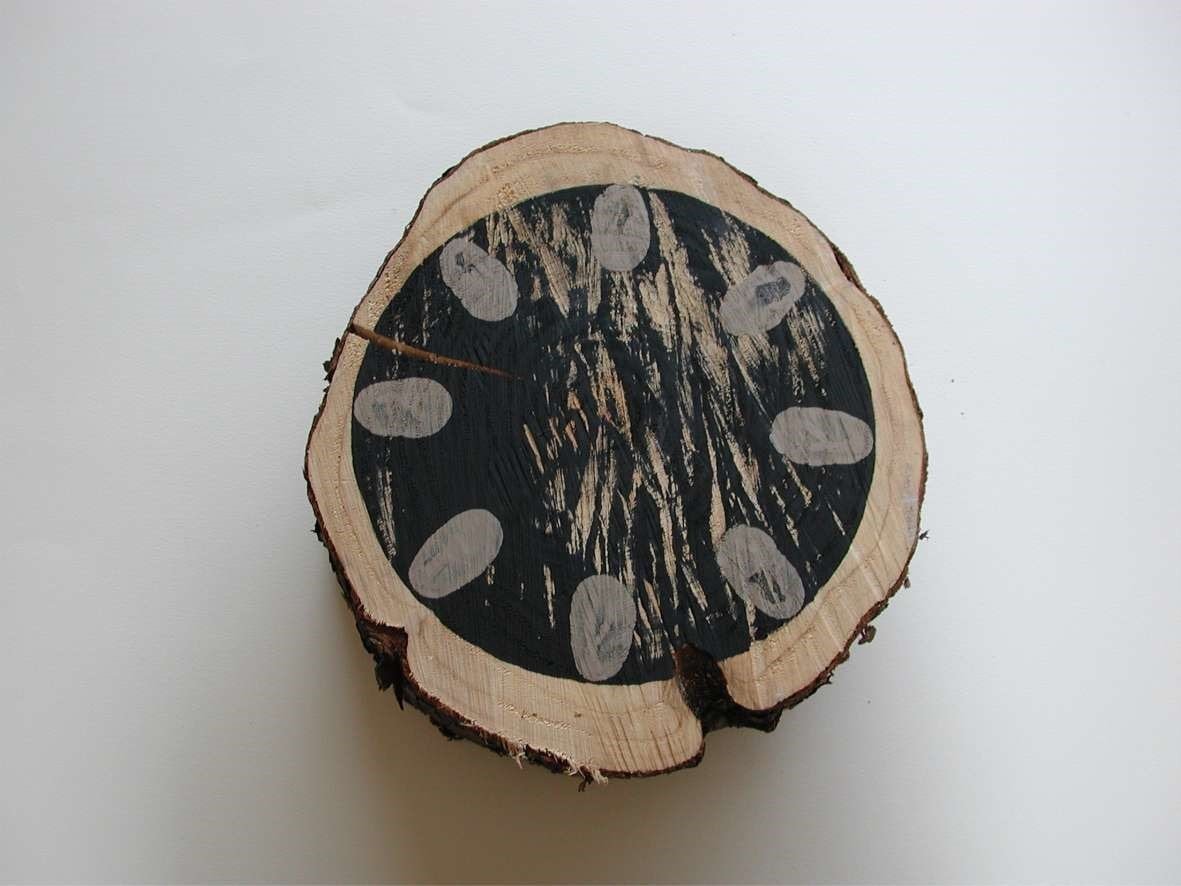
Richard Long
Untitled, 2005
River Avon mud on tree trunk, signed and dated underneath
Height: 25cm, Diameter: 22.5cm
Height: 9 13⁄16 in., Diameter: 8 7⁄8 in.
Richard Long’s works in Avon mud have been a fundamental aspect of his practice from the outset. Sourced from the River Avon in Bristol where he was born, brought up, and currently lives, his fingerprint works render an autobiographical quality, as well as drawing upon cultural histories.
Each fingerprint work, sometimes applied directly onto the wall, sometimes on natural materials like driftwood and handmade paper, is executed both spontaneously and with a great deal of care over the rhythmic and meditative patterning. For Long, these works are analogous to drawing, providing a direct and natural means of recording.
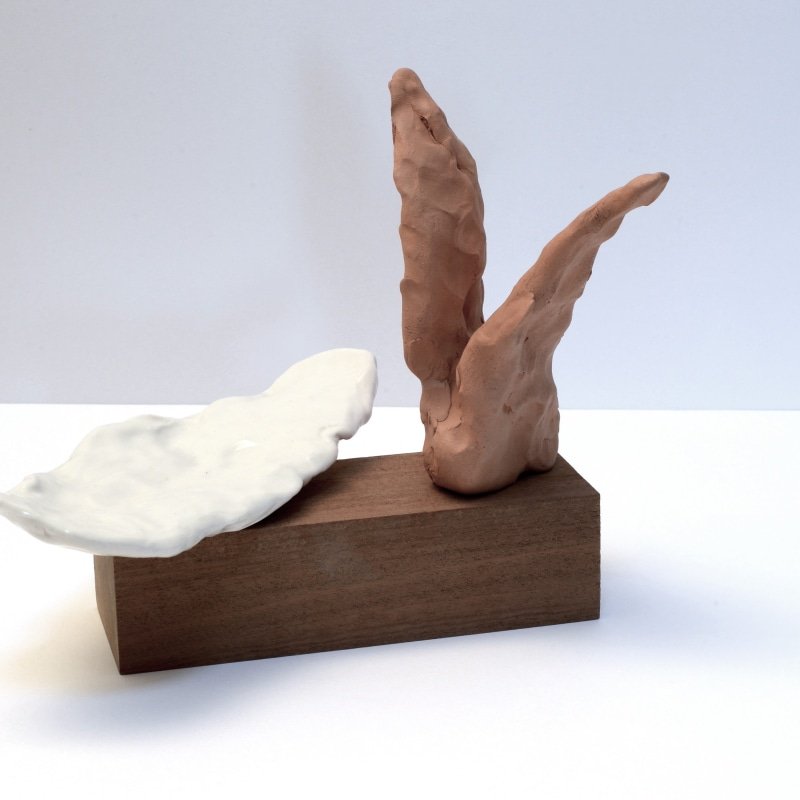
David Ward
Due palmi 2, 2024-25
Terracotta, porcelain and cherry wood
19 x 22.5 x 15.5 cm
7 ½ x 8 ⅞ x 6 ⅛ in.
There is an Italian term, ‘due palmi’ to describe the height of a sculpture, as a means of measurement. It means ‘two hands’. The same two hands at the centre of David Ward's recent exhibition: Touching Light are the two hands that made these terracotta and porcelain pieces. We can see the evidence of the makers hands pressed into the sculpture. As such, Ward named the piece Due palmi for the two hands that are simultaneously the creator and the creation. Inspired by Belini's angels, also described as 'due palmi', the terracotta sculpture evokes the image of wings and flight.