
In the Artists House | Victor Pasmore
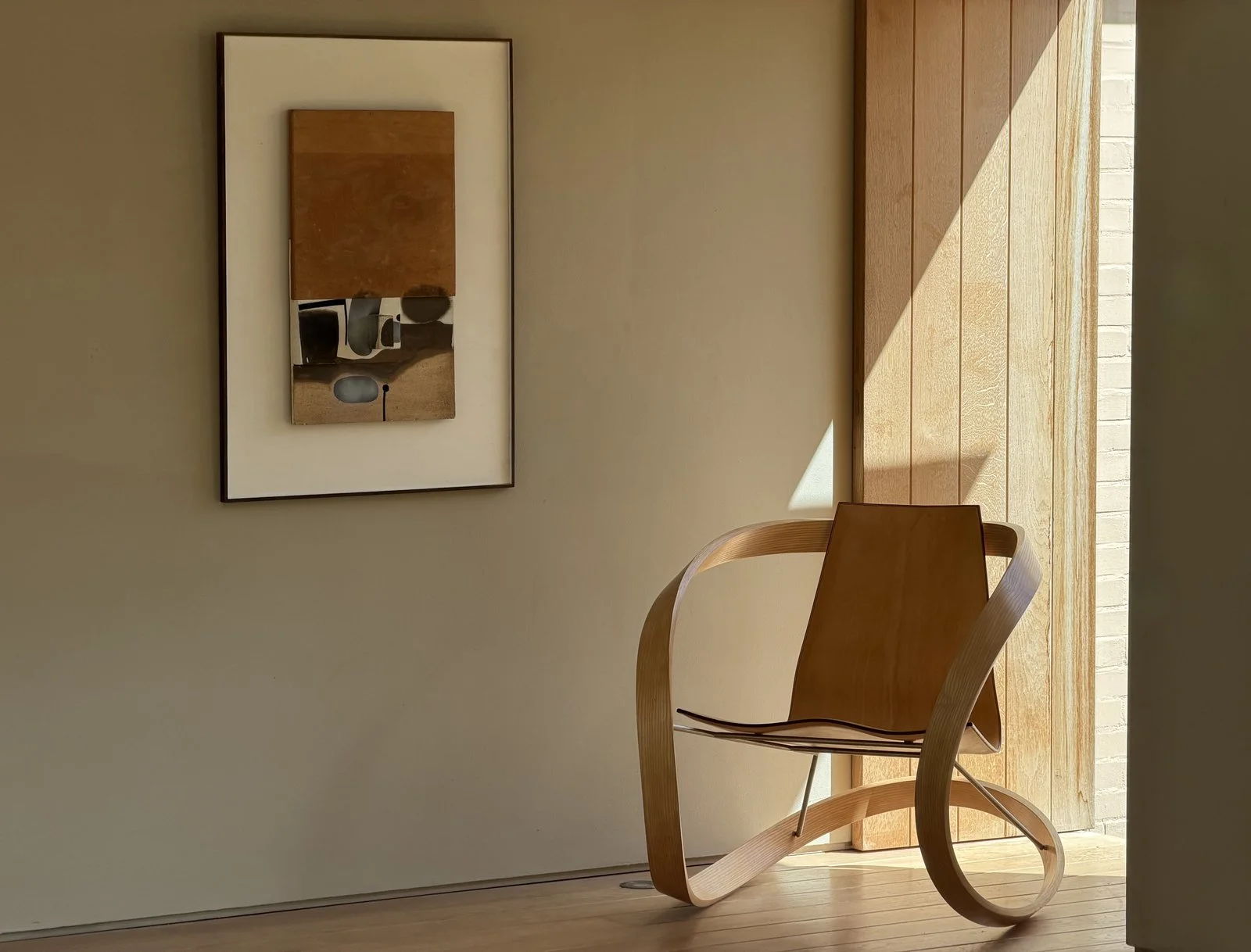
Victor Pasmore
Brown Symphony
1975
Oil on natural wood projective painting
99.5 x 72 x 10 cm
39 1/8 x 28 3/8 x 4 in.
Katie Walker
Ribbon rocking chair
Designed 2006, Made 2018
Ash, brushed stainless steel and natural vegetable tanned saddle leather
86 x 79 x 113 cm
33 7/8 x 31 1/8 x 44 1/2 in.
The New Art Centre is showing four works by Victor Pasmore on the top floor of the Artists House. A pioneering abstract artist, Pasmore was known for his collages, constructions and paintings. From 1947 onwards, he heavily experimented with abstraction with the encouragement of Lord Clark.
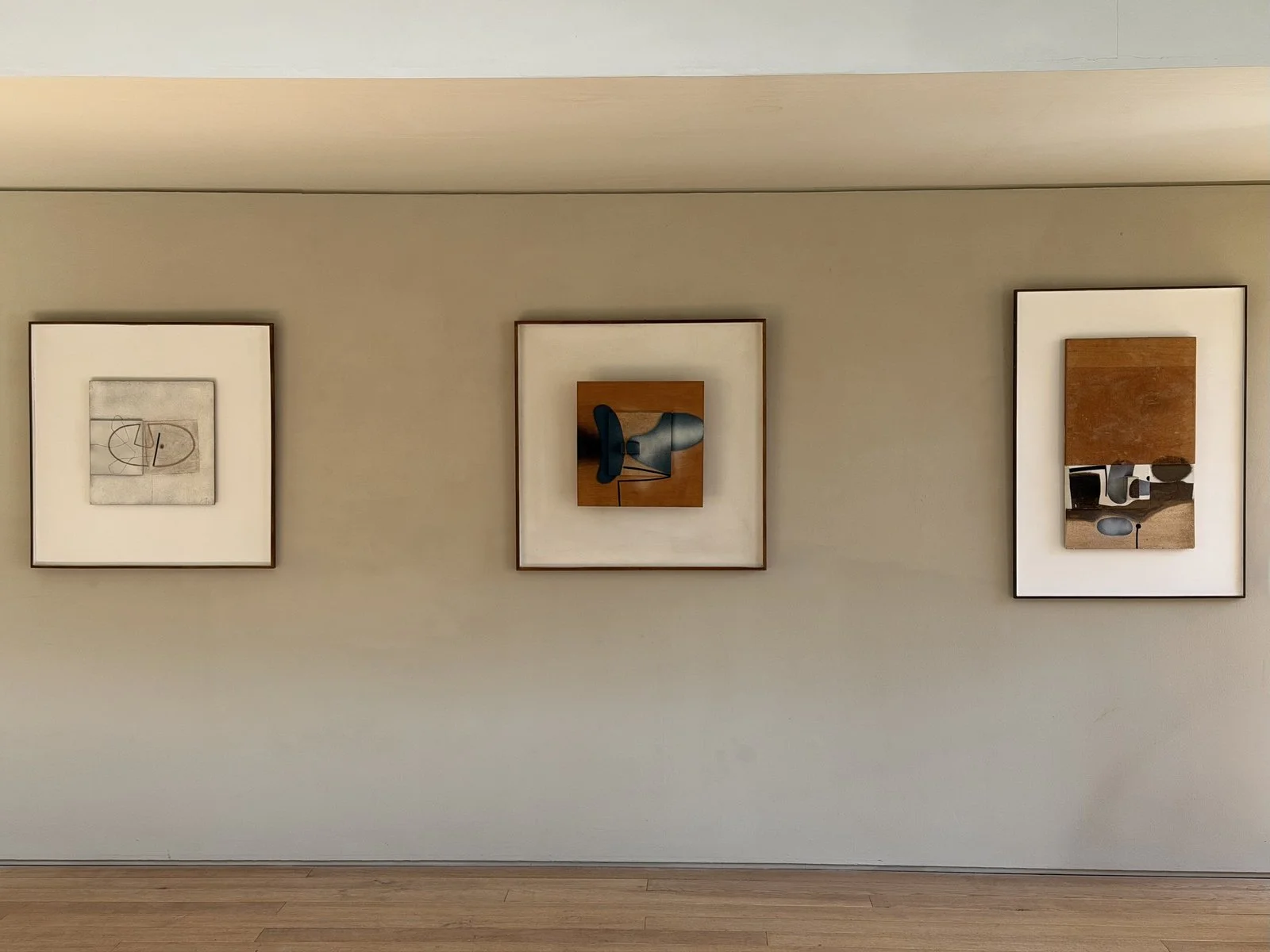
Victor Pasmore
Linear image in 2 movements
1975
Paint and gravure on board
80 x 80 x 3.2 cm
31 1/2 x 31 1/2 x 1 1/4 in.
Victor Pasmore
Point of Contact: Brown Development
1971
Oil on board & plywood
82 x 82 x 14 cm
32 1/4 x 32 1/4 x 5 1/2 in.
Victor Pasmore
Brown Symphony
1975
Oil on natural wood projective painting
99.5 x 72 x 10 cm
39 1/8 x 28 3/8 x 4 in.
Born in Surrey in 1908, Pasmore’s early work reflected developments in art in France in the late 19th century, and he worked as a successful representational painter of still life and landscapes. In 1949 he began teaching at the Central School of Arts and Crafts, and subsequently became Head of Painting at King’s College, Durham University, from 1954 until 1961. He was keen to develop abstract art as an element of the built environment, and as Consulting Director for Urban Design (1954-77) in Peterlee New Town, County Durham, he designed the layout and architecture of the south west area of Peterlee New Town, with the corporation’s architects. Throughout his career his work has been included in several major retrospective exhibitions, including at the ICA (1954); The Cambridge Arts Council Gallery (1955); and the Tate Gallery, London (1965 and again in 1980). In 1960, Pasmore represented Great Britain at the 30th Venice Biennale, and again at the 8th São Paulo Biennial in 1965.
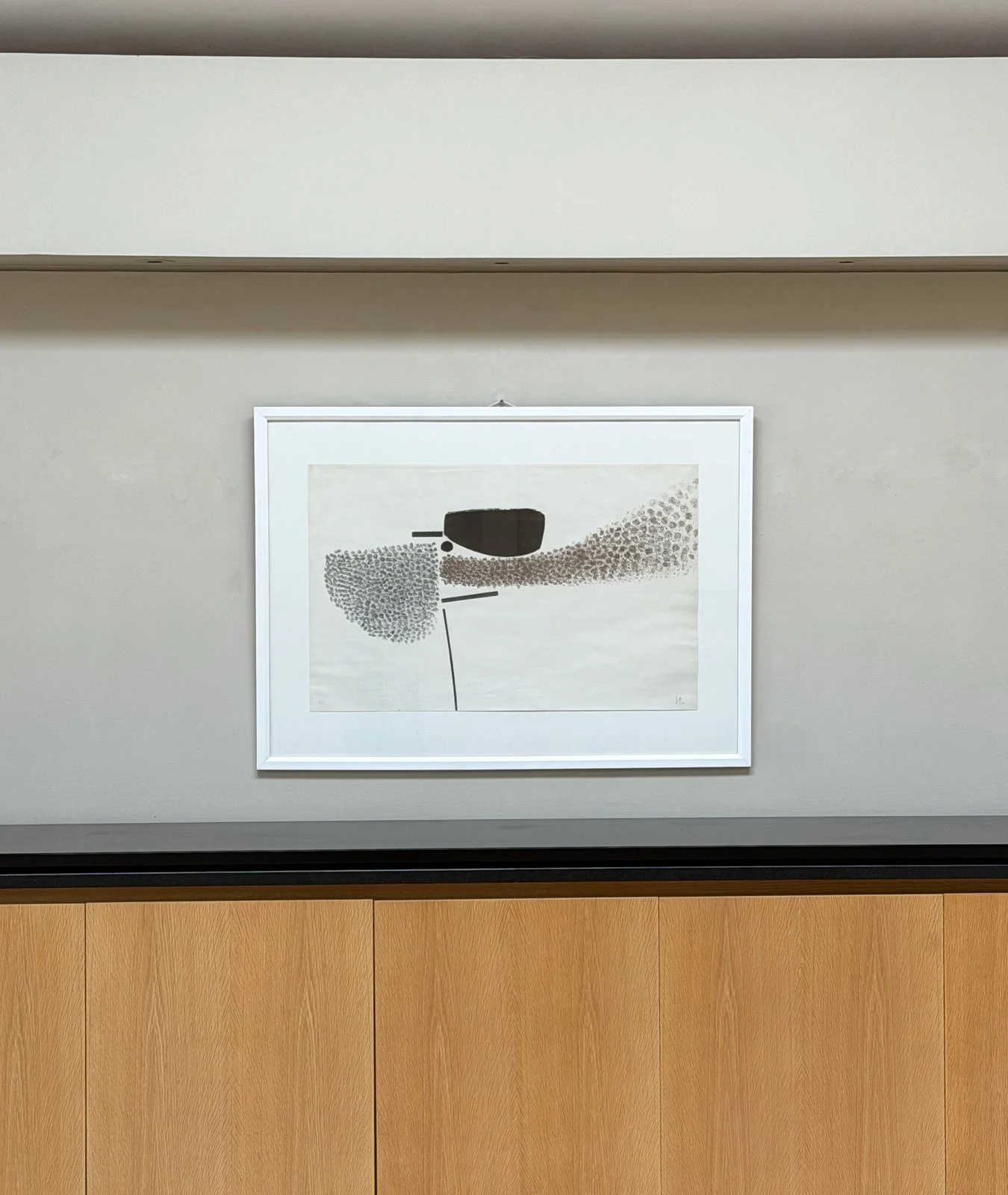
Victor Pasmore
Points of Contact No.2 (Lynton 3)
1965
signed and dated in black ink
Lithograph printed in colours
58.4 x 90.8 cm
1ft 11 x 2ft 11 ¾ in.
Edition 62 of 70
Pasmore's Points of Contact works were explorations in painterly techniques of light, texture, space and movement. This lithograph marks his shift in practice in the 1960s and 1970s, from geometric design and constructivism that paralleled the work of Kenneth and Mary Martin in the 1950s, into lyrical composition of points, nodes, wandering lines and planes of bright colour. Pasmore’s interest in creating graphic works showed early in his career as an abstract artist with his first linocut in 1951. He also experimented with oil and gravure in his paintings on board. From the mid-1960s he explored etching and aquatint focusing on the interplay between solid colour and line, later focusing on screen prints and lithographs, working with different print studios in England and Italy.